
History
Fragmented Nations
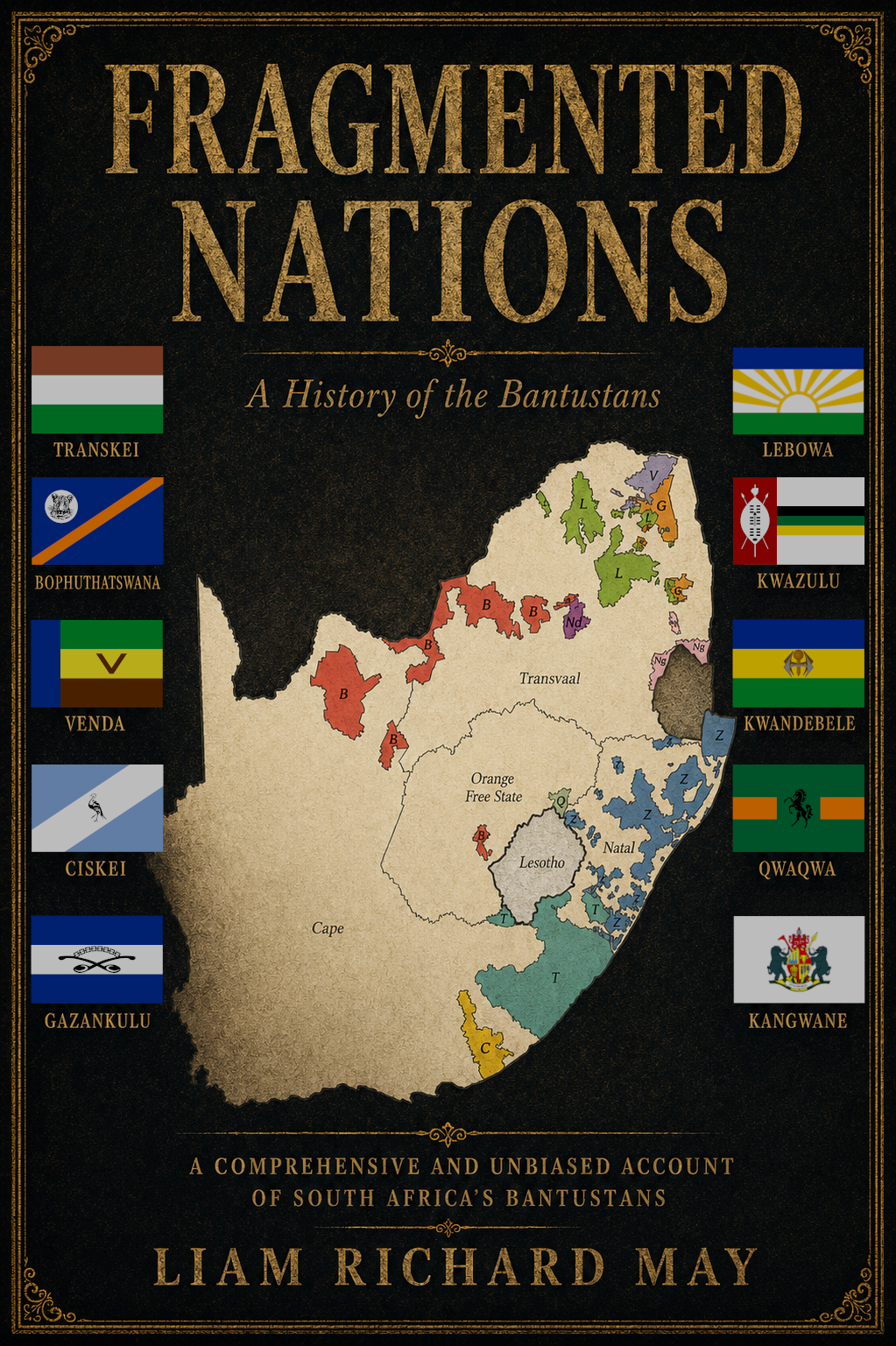
Between 1976 and 1981, four “independent republics” were declared inside South Africa’s borders, and six more homelands governed themselves in part. By 1994, all ten were gone. Fragmented Nations
tells their story from the ground up: the laws that shaped them, the men who built and led them, the people who lived in them, and what they left behind.
On a warm October morning in 1976, a man stood at a border post in the Eastern Cape and learned that
he had become a foreigner in the country of his birth. He had not moved. The border had moved around
him. Between 1976 and 1981, four “independent republics” were declared inside South Africa: Transkei,
Bophuthatswana, Venda and Ciskei. Six more territories governed themselves in some matters and
remained South African in others. To the government that created them, they were homelands, the
rightful home of each African nation. To their critics, they were Bantustans. To the millions who lived
in them, they were simply home. By 1994, all ten were gone.
Fragmented Nations is a complete history of the Bantustans. It begins with the territorial skeleton laid
down by the Natives Land Act of 1913. It follows the slow building of segregation, and Hendrik
Verwoerd’s work turning it into the doctrine of separate development. It then shows how that doctrine
was tested in the Transkei. The book follows the Soweto uprising of 1976 and the collapse of the early
1990s. It then takes each of the ten homelands in turn: Transkei, Bophuthatswana, Venda, Ciskei,
KwaZulu, Lebowa, Gazankulu, QwaQwa, KaNgwane and KwaNdebele. For each one, it covers the
leaders, institutions, economies and conflicts, and how the homeland ended. The final chapter weighs
the reckoning of 1994 and what the homelands have left in South Africa today.
This is not a polemic. The book draws on government archives, the records of the liberation
movements, the findings of the Truth and Reconciliation Commission, the memoirs of the homeland
leaders, and decades of published scholarship. It sets competing accounts side by side, and it says
plainly where the record is clear and where it is contested. Its aim is a history that a defender of the old
National Party and a veteran of uMkhonto we Sizwe could each read, and each close saying the author
took their side seriously.
Four reference appendices are included: a cast of principal figures, a glossary of South African terms, a
chronology from 1652 to 1994, and an annotated bibliography.
More Books

Coming Soon
Stay Tuned
Coming Soon
Stay Tuned
Coming Soon
Stay Tuned

Liam Richard May
Liam Richard May is a South African historian and author based in Pretoria, and the founder and director of Volkskild. His work focuses on the political and social history of southern Africa, written on one principle: history must be recorded as it happened. His published work includes
Fragmented Nations: A History of the Bantustans.
Copyright © 2026 Divi. All Rights Reserved.